Profiles in Hope, John Brogden | Book 88, July 2025
Profiles in Hope, John Brogden | Book 88, July 2025
Before I get into this, I want to acknowledge that this is a heavy post. I know we can’t always control what we see online, and reading about suicide can bring up strong feelings. Personally, I don’t believe a “trigger warning” fixes the impact — it can sometimes feel like a bandaid rather than real support.
If you choose to keep reading, please take care of yourself in whatever way you need.
ASIST Training
It’s been a week since I stepped into the training room for ASIST (Applied Suicide Intervention Skills Training). Last week, Profiles in Hope by John Brogden finally arrived at the library for me after weeks on the waitlist — a strange but fitting coincidence.
ASIST was two intense days focused on one of the most important (and toughest) topics: suicide.
In Australia in 2023, our population was 29,946,369. That same year, 3,214 people died by suicide (as determined by a coroner), and 1,347,318 people had thoughts of suicide. These are huge numbers, and behind each one is a real person.
Our ASIST group had around 20 people: PhD students, peer supporters, volunteers, people working directly with students, and some from the MHFAO (Mental Health First Aid Officer) network.
• 50% of us knew someone who had died by suicide.
• 80% knew multiple people who had shown suicidal behaviour.
• 60% identified as helpers supporting people with suicidal behaviour, with slightly more supporting in a personal capacity than through work.
• 3 people had thoughts of suicide in the past year.
When we talked about what shaped our understanding of suicide, personal experience ranked highest, followed by books and newspaper articles. Next came job-related experience, the internet, and workshops/lectures (tied), then media like TV. Only 2 people said they had never had any thoughts or feelings about suicide.
Two people in the group had experienced suicidal behaviour with a clear wish to die at some point in their life, while seven had shown suicidal behaviour but felt unsure about actually wanting to die.
This really highlights something important: when people say suicide feels like the “only option,” deep down many still want to live, they just want the pain to stop.
This training also supports my MHFA (Mental Health First Aid) accreditation and is essentially suicide first aid practical, immediate, and lifesaving.
All of this feels even more urgent given the recent decision to defund Suicide Prevention Australia’s Suicide Prevention Research Fund (SPRF). Since 2018, the SPRF has supported research across 27 universities, informing real-world policy and practice. Just recently, Suicide Prevention Australia sent a petition to the Australian Government calling for the reinstatement of the SPRF. This included 555 handwritten signatures from researchers, clinicians, service providers, people with lived experience, and advocates.
The decision to cut this funding came right after the Productivity Commission recommended strengthening suicide prevention through research and evaluation — the exact opposite of what’s happened.
Profiles in Hope (Notes)
This is a book review, and it’s important to share that this isn’t sugar-coated. It’s raw and honest right from the start.
On page one, there’s an important note to readers:
“Profiles in Hope is a book of hope and hopeful stories of suicide and survival. These stories take the reader through very dark places before climbing the mountain of renewal.”
Following this, on page two, there’s a note about writing about suicide that raises important points about media coverage and language.
Some extracts I found especially relevant — because we can’t escape digital media, and it’s crucial that content about suicide strikes the right balance between being authentic, honest, and supportive:
“The way suicide is written about and reported is very important. Getting it right ensures we talk about suicide responsibly and don’t hide it in a dark corner.”
“…Getting it wrong can cost lives.”
“It is most appropriate to say that a person has died by suicide.”
“While it is appropriate to report that someone has died by suicide, the means of suicide — the details of how the person took their life — should not be described in detail.”
During ASIST training, I asked a lot about language, as I don’t agree with the phrase “commit suicide.” Over the years, this wording has shifted, and for good reason. Suicide was decriminalised across Australia between the mid-1950s and early 1980s, with Western Australia being the last state to do so in 1983.
“Suicide is not a crime; it is a human tragedy.”
“Mindframe is a national program supporting safe media reporting, portrayal and communication about suicide… Mindframe’s guidelines on writing about suicide have been used in writing this book.”
Incase you were wondering about the guidelines in media for this topic.
Profiles in Hope (My review)
The book shares stories from a range of people who were asked a series of questions about their lives, struggles, and turning points.
I was surprised to see Layne Beachley featured as the first chapter. Back in January, when I read my first book of the year (The Salt Water Cure), I learned that Layne one of Australia’s surfing icons was the child of date rape, born six weeks premature, and adopted out by her teenage mother (whom she later met). She didn’t find out she was adopted until her adoptive mother passed away when she was just seven years old. This chapter touches on that history too. And I had no idea until reading this book that Layne is married to Kirk Pengilly from INXS.
Layne shared how she would constantly seek love externally. Her relentless drive in surfing was tied to her need to feel worthy an experience she connects to being adopted. She had an epiphany after winning her sixth world championship: it wasn’t the trophies that mattered, but the feeling of finally being worthy of love. To reach that point, she felt she had to become the most successful surfer in history.
The chapter also explores her relationship with her adoptive mother the push and pull dynamic. Her mother pushed to connect; Layne pushed her away. When Layne eventually tried to reconnect (when she had space away from competitions and work), her mother then pushed her away. On her deathbed, her mother revealed that Layne had been written out of her will. Despite all this, Layne remains deeply community-driven. She knows the more you give to others, the more you need to pour into yourself. No matter what else is happening, she always makes time for the ocean her grounding place.
Another story is from a teenager, Matthew Caruana, who survived a non-fatal suicide attempt but now lives with a spinal injury and uses a wheelchair. He described the moment he entered “the void” and thought, finally. Today, he does public speaking and inspires young people with his honesty and strength.
There’s also the story of Patricia Hall, a wife and mother who spiralled for years after discovering her husband’s infidelity. She eventually found her way forward after a serious accident in the shower she blacked out while washing her hair, which led to burns over 17.5% of her body and 9.5 weeks in hospital. Patricia later went on to receive an Order of Australia Medal (OAM) in the 2022 Australia Day Honours List for her contribution to the Liverpool community. She has spent more than 30 years making a difference through her work as CEO of Liverpool Neighbourhood Connections.
There are big names throughout the book Jackie Lambie, who I found so relatable and raw in her responses; Ian Thorpe, who surprised me when he appeared on the pages; and other recognisable names like James Packer, Tom Boyd, and Preston Campbell.
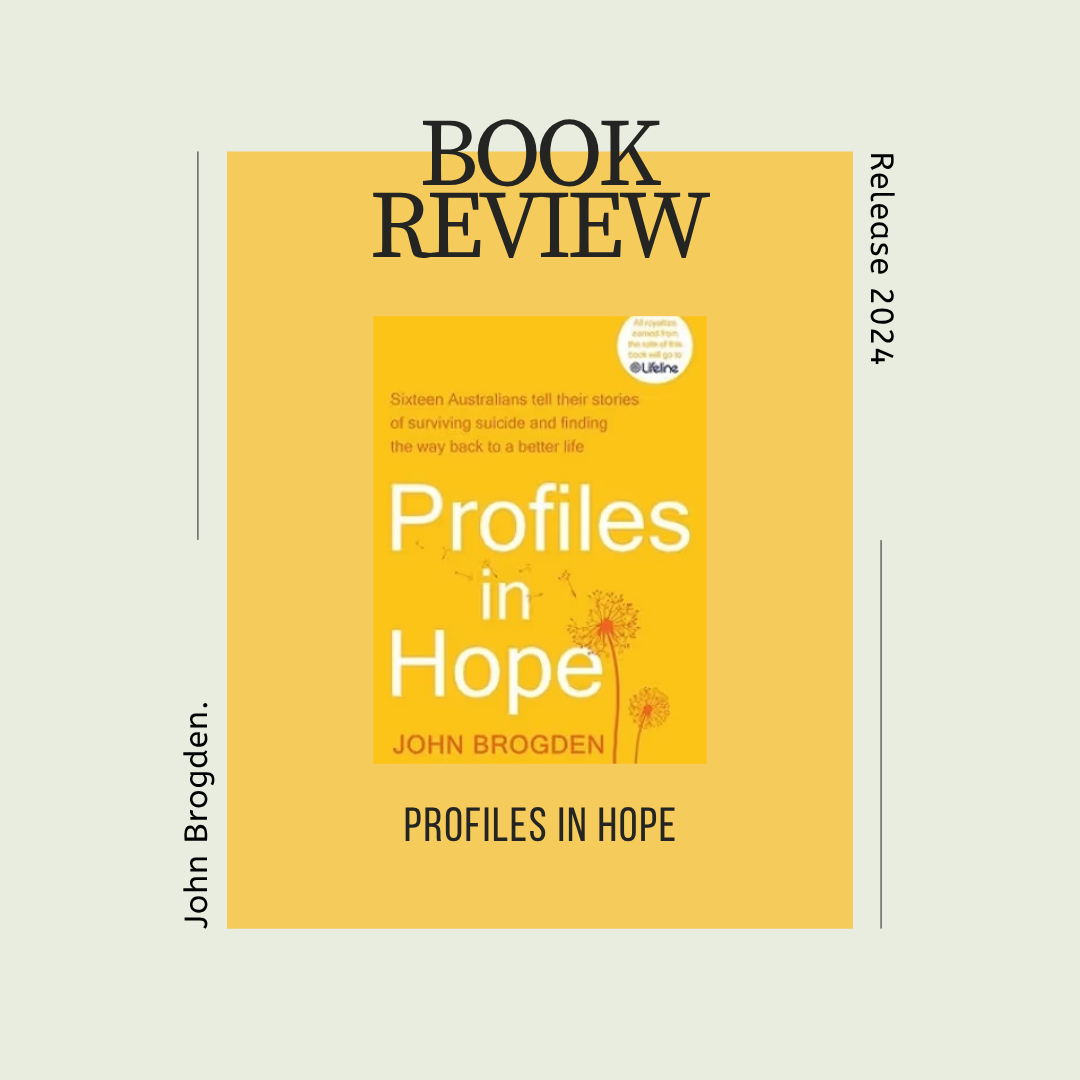
Profiles in Hope brings together fifteen Australians a mix of public figures and everyday people who share deeply personal stories of surviving suicide and finding their way back to life. John Brogden, who came close to taking his own life nineteen years ago, knows both personally and professionally how important it is to talk openly about suicide and to show that there is a way forward, even from the darkest places.
These stories don’t gloss over the pain. They are searingly honest and sometimes hard to read, but they always return to the possibility of hope and renewal. They’re for anyone who has felt lost, for those supporting someone in crisis, and for anyone needing to be reminded that survival and even thriving is possible.
All royalties from this book go to Lifeline, which feels fitting given how deeply these stories are meant to help and give back.


Comments
Post a Comment